Introducing the Timeless Record.

A person stands with a laptop before a wall of vertical light lines rising from a reflective floor.

A New Security Substrate for a New World

The Polyglyf seals and records every software operation as it runs in order to provide a timeless record of your proprietary and confidential digital assets.

That timeless record is executed on silicon and anchored on a tamper-evident chain of events to create what we call The Ground-State Record.

The Ground-State Record does three things: first, it preserves the recorded sequence of your software events; second, in real time, it blocks violations of that chronology; third, it gives you a time-certain restoration point for restoring your digital assets to the moment before they were compromised.

Wherever your assets may be, the Ground-State Record is their original source of truth and their timeless protection.

The Ground-State Record

The Polyglyf Creates a Permanent Record in Time.

Everything that happens is a sequence. The Polyglyf preserves that sequence on an unalterable record. As software runs, each operation is bound and sealed in order, creating a permanent timeline that serves as the adjudicator for everything that happens thereafter.

The past cannot be rewritten. An attacker who gets inside cannot take any action without adding evidence to the official record that accumulates as the attacker moves from one action to the next.

Patents pendingBindingSealingThe Ground-State RecordHardened modeGoverning AI actionsRestoration pointsFrame-dynamic media authentication
POLYGLYFConsole · Federated CensusLIVE
Federated CensusYour protected deployments on one map
Color byHealthTEE vendorCloudAll vendors ▾All clouds ▾6 of 6 shown
us-east1us-east1us-east1us-central1us-west-2europe-west3
Health legend
Healthy4Degraded1Fail-closed0Pending1
By region6 deployments
us-east1
us-central1
us-west-2
europe-west3

The Console

Deploy our protection. Then, every software operation, byte of code, frame of film, or note of a song seals onto an immutable record. That becomes the ground truth. Whatever happens to your protected assets afterward is judged against the original source.

See the console Request a briefing

The Polyglyf Binds Every Operation Into One Chain of Trust.

The Who

Operator identity

The What

Your code, every operation

The Where

Silicon-level proof

The When

Monotonic time

The Proof

Zero-Knowledge Proof

Prove exactly what happened while revealing nothing about the data.

One proof of execution for every operation.

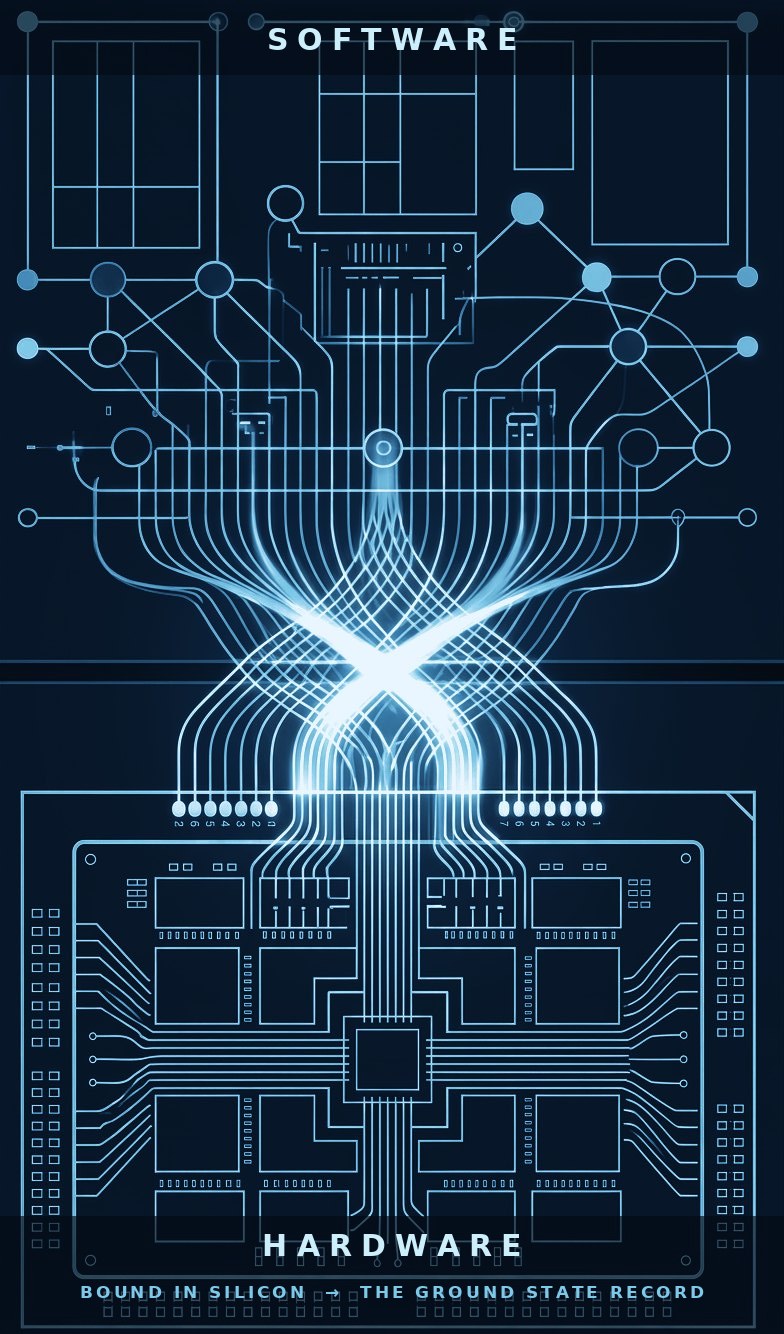
The Ground-State Record.

Software fusing into hardware, top to bottom, to create the Ground-State Record.

What it Protects

Cyber Security

01How do you protect your software after your firewall has been breached?

02When you restore after a breach, how do you find the moment in time your code and data were still clean?

03How do you integrate AI into your enterprise while also holding AI accountable?

Protection that Survives Exposure.

The Polyglyf focuses its protection on the primary targets of an attack, the core contents inside the perimeter. An attacker's real target is your software code and your confidential data, like credit cards, financial data, or government secrets. Stated succinctly, an attacker wants to cripple your code or steal your secrets.
The Polyglyf solves this problem.
The Polyglyf protects your confidential assets even when your perimeter has been breached or your assets have been sent out the front door.
The Polyglyf travels with your confidential assets, protecting them no matter where they go.
The Problem with Cyber Security
We have a limited window to strengthen cyber defenses
Open letter of August 27, 2026, signed by more than 100 companies, Cisco among them. It puts that window at months, not years.

Market Pressure

The security market is growing because the attacks are growing in number, and now with AI-enabled sophistication.

+89%
AI-enabled attacks rose 89 percent in 2025.
88%
Attackers now obtain 88 percent of newly disclosed exploits within 48 hours.
$4.99M
The average breach costs $4.99 million, a record.

AI-enabled attacks rose 89 percent in 2025. Attackers now obtain 88 percent of newly disclosed exploits within 48 hours. The average breach costs $4.99 million.

The Size of the Problem

The pressure driving demand arises from the same underlying exposure: the attacker gets inside before the defender can discover what's happened. Once inside, the intruder can rewrite logs to hide their tracks.

Enterprises will spend $244.2 billion on information security in 2026.

Today's $244.2 billion market is focused on buying cybersecurity solutions that provide perimeter control, detection, and response. The Polyglyf sells the one thing that is missing in the market today: an immutable record of software operations to establish an ongoing source of truth that survives exposure.

Information security spend, 2026 Gartner$244.2B
Security software, the fastest-growing part Gartner, reaching $121 billion in 2027$106B

Bars are to scale. The Polyglyf sells into that whole layer, because it is a substrate rather than a category. It seals every protected software operation as it runs and gives every product above it, a SIEM, a data security tool, a confidential computing platform, the same sealed record to check against.

+28.8%
Cloud security, the fastest-growing subsegment in 2026.
$28.1B
US federal cybersecurity budget, FY2026: $13 billion civilian and $15.1 billion Defense.
$244.2B Dec 2025
$246.2B Mar 2026
$248.9B Jul 2026
Gartner's 2026 forecast, raised twice within the year.
Sources: Gartner, Forecast: Information Security, Worldwide, 4Q25, 1Q26 and 2Q26 updates; Congressional Research Service IN12616 and the FY2026 federal civilian cybersecurity budget; the August 27, 2026 open letter.

What Happens When the Threat Gets In?

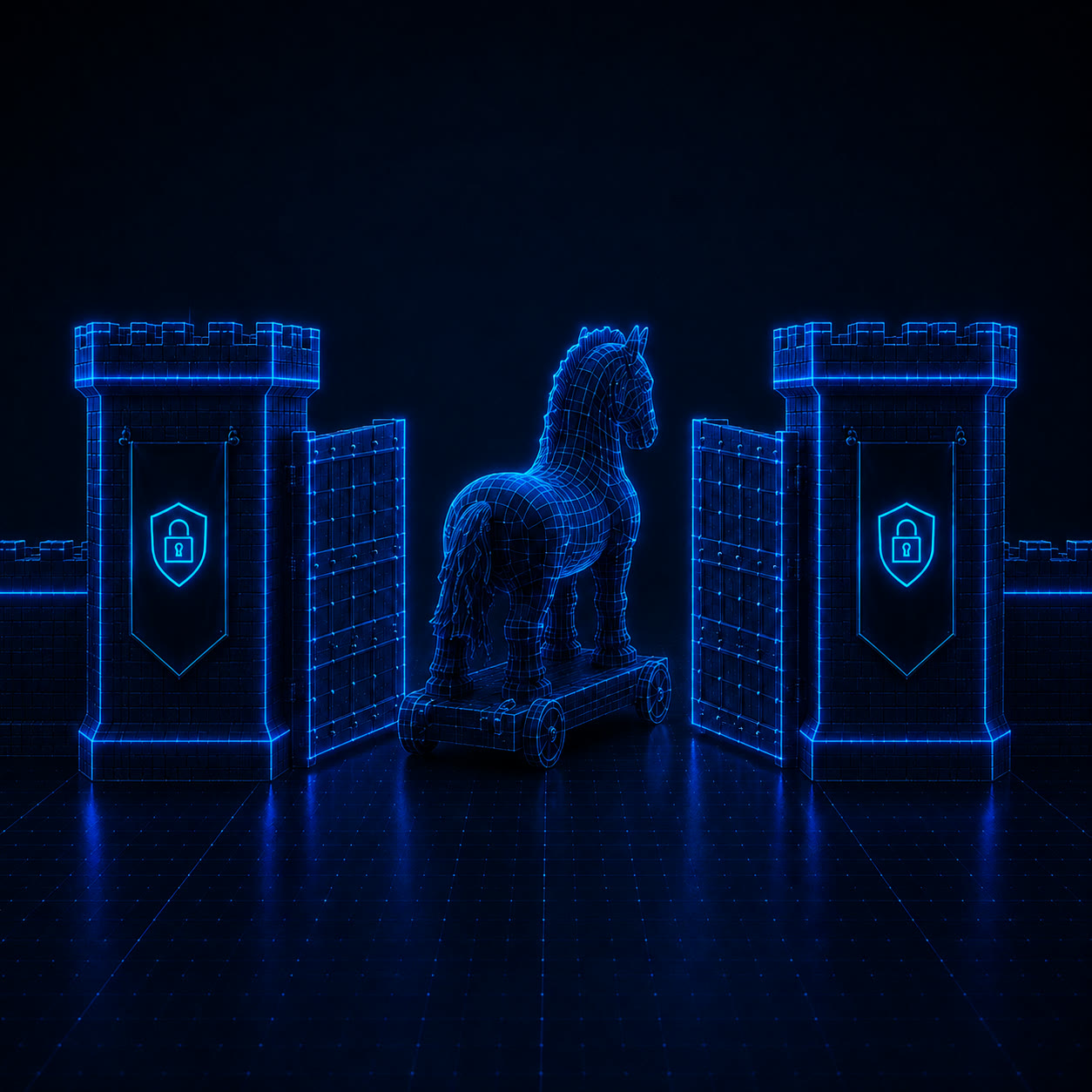
Most cybersecurity works like a castle wall. It protects the perimeter and decides who gets through the gate, but a perimeter only protects until it is breached. The Polyglyf protects your assets even after the threat gets inside.
Protection also continues even after you send your assets out the door.
When you distribute
CodeRecordsFilmMusic
A glowing blue wireframe Trojan horse standing inside the opened gates of a fortified wall.

Protecting Your Core Assets

Traditional cybersecurity works like a protected perimeter, a castle wall, focusing primarily on its ability to distinguish attackers from legitimate users. Unfortunately, holes exist in the castle wall and even when a perimeter's integrity is 100%, user credentials can be stolen.

Software operations run on software logs, but once past your perimeter, intruders can corrupt your code and your data and then rewrite those logs to cover their tracks. As a result, your accountability rests on records that could have been altered without your knowledge.

The Polyglyf fixes that.

As your software runs, the Polyglyf binds and seals each operation on an official record.

That sealed chain of operations is The Ground-State Record.

That record cannot be rewritten. Every action that follows is judged against its original timeline of events.

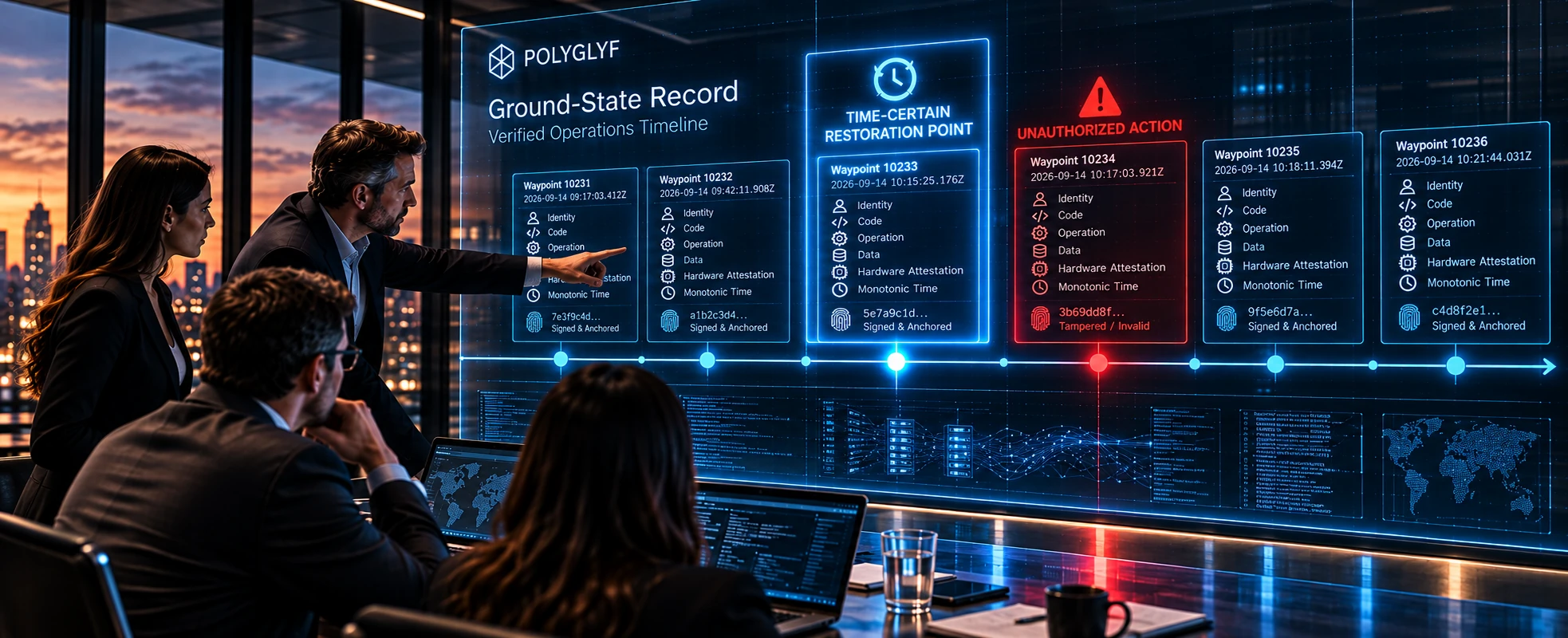
And when you need to restore your data after a breach, the Ground-State Record gives you a chained and recorded history of software events, and in that chronology, you can find the time-certain restoration point before your code was compromised so you can restore your code from a moment in time when it was clean.

The Ground-State Record persists on its own as the ultimate source of truth.

Executives review a Ground-State Record timeline: sealed waypoints, a time-certain restoration point at waypoint 10233, then an unauthorized action at 10234 marked tampered and invalid.

A Time-Certain Restoration Point.

The past cannot be rewritten. Everything written to the Ground-State Record before the intrusion is unchanged, because the attacker could not reach it.

The Polyglyf gives you a time certain restoration point to rely on when you are restoring your code and data from a moment in time before the breach.

Precision Protection

One Proof of Execution for Every Software Operation.

The world is transitioning from border security, to application security, and the final evolution is operation-by-operation security, where we provide protection at a much finer detail than any other security solution on the market today.

01 · Original Solution

Border Security

One Perimeter Around Everything.

02 · Evolution

Application Security

One Boundary per Application.

03 · Culmination

The Polyglyf

Each Software Operation is Sealed on the Record as it Runs.

Hands-Free
Compliance

Compliance is onerous and time-consuming. The Ground-State Record creates a mathematically verifiable chain of software operations that becomes your new compliance substrate. Automate evidence collection, reduce audit friction, and make verification continuous.

Automate compliance with the Ground-State Record.

COMPLIANCE STEPS GROUND-STATE RECORD 01 02 03 04 05 06 COMPLIANCE STEPS GROUND-STATE RECORD 01 02 03 04 05 06
Compliance Regimes
SOC 2HIPAAISO 27001PCI DSSGDPRCCPANIST 800-53

AI Accountability

01How do you securely run your AI model or your software on third-party hardware you don’t control?

02How do you govern the behavior of AI Models without relying on them to govern themselves?

A person stands on a terrace at night before a line of light that runs to the horizon, carrying a sequence of frames.

A New Security Substrate for a New World.

AI is changing the nature of cybersecurity. Software no longer simply stores information or waits for a human instruction. Autonomous systems can reason, call tools, execute software, interact with other systems, and increasingly act in the physical world. As those actions scale in number and sophistication, security must move beyond protecting the perimeter to protecting each operation as it runs.

The Polyglyf seals and records every protected software operation to create an ongoing source of truth that survives exposure. Instead of adding another wall around an increasingly autonomous world, the Polyglyf creates a security substrate beneath it. Protection persists wherever software operates and wherever your digital assets go.

Four executives in a boardroom review the Ground-State Record timeline on a large screen.

AI, Unconcealed.

Trust begins beneath the model, not within it. Today, AI is a black box. The Polyglyf does not rely upon the model itself to obey its own rules or report on its own behavior. Instead, the Ground-State Record reveals its operations by recording each protected software action as it runs. Not a single token can hide.

The who, what, where, and when are bound into one chain of trust: operator identity, the operation itself, silicon-level proof, and monotonic time. The result is a verifiable history of what actually happened. Through zero-knowledge proof, that history can prove exactly what happened while revealing nothing about the protected data itself. AI may remain extraordinarily complex, but its actions no longer need to remain concealed.

AI Is a Black Box to Your Organization.

#OperationOperator IdentityHardware AttestationMonotonic TimeSealVerdict
01Model weights loadedsvc-inference-02NVIDIA NRAS09:14:02.118a3f1…9c2eSealed
02Prompt receivedoperator-aNVIDIA NRAS09:14:02.3017d0c…41b7Sealed
03Tool call: records querysvc-inference-02NVIDIA NRAS09:14:02.944e88a…c05dSealed
04Output returnedoperator-aNVIDIA NRAS09:14:03.51251be…7f30Sealed
05Output altered after releaseunknownnone11:02:17.006—Does not match
Illustrative record. Column names are the elements of the record.

The Ground-State Record reveals its every operation, holding AI accountable for each and every action in the chain of events.

The Ground-State Record is an unalterable timeline that holds AI accountable while protecting your digital assets.

Executives in a boardroom watch a red storm of attacks break against a glass wall marked Ground-State Record; beyond it stand Government, Financial Services, Healthcare and Critical Infrastructure.

Govern What AI Can Do.

Accountability should not begin after an autonomous action has already occurred. The Polyglyf creates operation-by-operation security. Each protected operation is evaluated as it runs, allowing unauthorized actions to be refused while authorized actions are sealed into the Ground-State Record.

This moves AI governance outside the model itself. The system does not depend upon an autonomous agent voluntarily obeying its own restrictions or accurately reporting what it has done. The Ground-State Record provides an independent security substrate against which actions can be governed, recorded, and verified. Every allowed action becomes part of the official record. Every refused or unauthorized action becomes discoverable.

A layer of AI models, code, video and robotics floats above a glowing chip marked Ground-State Record, with Identity, Operation, Hardware, Time and Attestation along its edge.

Trust Begins Beneath the Model.

Not within the model. Beneath it.

The Polyglyf does not ask AI to audit itself. It establishes trust beneath the model, at the hardware layer where software actually executes. The Polyglyf runs inside a Trusted Execution Environment and binds hardware attestation into every record it seals, creating silicon-level proof of where each operation actually ran.

Each operation seals the Ground-State Record as it runs. Code, hardware, operator identity, time, and operation are bound into one chain of trust. Intel, AMD, NVIDIA, AWS and other Confidential Computing platforms may attest differently. The Polyglyf folds those attestations into one record with one shape, creating a hardware-rooted source of truth independent of the model operating above it.

Six panels: a drone, robot arms on a factory line, a self-driving car, a semi truck, an airliner taking off, and a delivery van.

Accountability Follows AI Into the World.

AI is leaving the data center and entering the physical world. Robots, autonomous vehicles, drones, industrial systems, and other AI-enabled devices increasingly execute software on hardware built and operated by third parties. The Polyglyf provides the security substrate that allows accountability to follow AI wherever it runs.

Every protected operation can be bound into the same Ground-State Record, whether it occurs on servers in the cloud or on an AI-enabled device in the physical world. The record identifies what ran, on whose hardware, under whose identity, and when. Wherever AI operates, the Ground-State Record persists as the source of truth by which its actions can be revealed, governed, and reviewed.

POLYGLYF Unlocks the Open‑Hardware Model for Physical AI.

The Polyglyf is the security substrate for an open-hardware ecosystem of Physical AI.

Foundation models can choose to integrate their AI openly with third-party hardware manufacturers while protecting their proprietary code, weights, and measures.

The Polyglyf enables AI to run securely on third-party hardware, whether that be on servers in the cloud or in any AI-enabled device: robots, autonomous vehicles, drones.

A white humanoid robot standing upright. Its head is open at the top to show a glowing circuit board, the AI model, above its face.
  • AI Model
  • Cybersecurity for your AI, no matter where it runs.
  • Third-Party Hardware

Protect your Model on Third-Party Cloud Hardware.

The Polyglyf Protects Your Model and its Weights and Measures

Spin up an attested Trusted Execution Environment (TEE): NVIDIA H100 Confidential Computing, Intel TDX, AWS Nitro, or AMD SEV-SNP.

The Polyglyf installs inside the trusted enclave, next to your code. Nothing runs outside the TEE.

Each operation seals the Ground-State Record as it runs. The Polyglyf never touches the GPU; it runs exclusively on the CPU. In 2.4 microseconds, the Polyglyf binds and seals each operation.

  • AI Model
  • Cybersecurity for your AI, no matter where it runs.
  • Third-Party Hardware

Wherever AI goes, accountability follows.

Media Protection

01How do you protect your film and music after you distribute it?

02How do you prevent deepfakes of your name and likeness or unauthorized changes to your content?

Your Media. The Permanent Record Protects It.

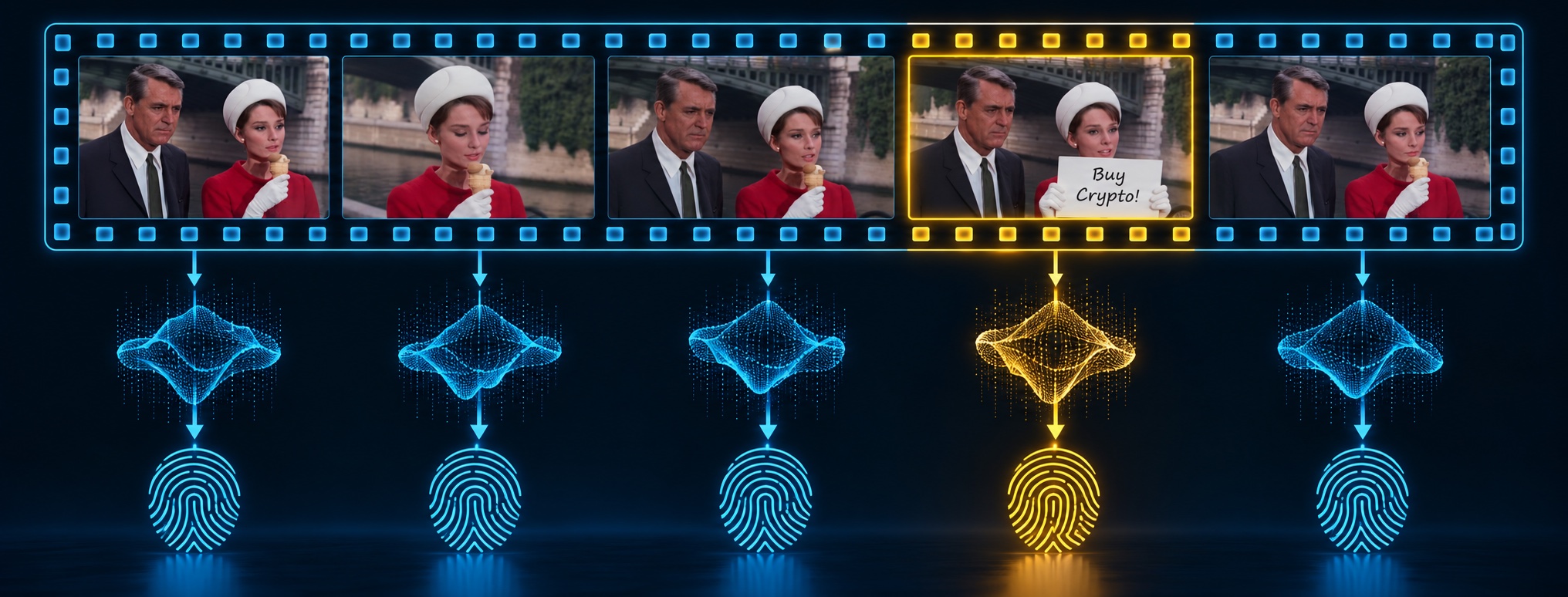
The Polyglyf is frame-dynamic. It changes shape with every frame, encoding the contents of each frame as the film plays. And while it encodes, it conceals: the cryptographic enclosure that seals the record is never revealed.
Frame by frame, the Polyglyf wave function, the contents of the frame, and the cryptographic enclosure are sealed together into a single immutable record. The film can travel anywhere. The record cannot be changed.
Patent pending · The Polyglyf and the Ground-State Record
A classic film scene held on a film strip and a glass frame, its contents expressed as a glowing blue wave riding a gold axis of time.

The Polyglyf protects your media even after you distribute it, no matter where it goes.

At the level of each frame, your media is bound and sealed. Unauthorized changes to your proprietary content are discoverable, trackable, and adjudicated against the original source.

Five frames of a film strip, each pointing down to its own Polyglyf wave and then to its own fingerprint. The fourth frame has been altered, and its wave and fingerprint glow amber instead of blue.
DEEPFAKED

Your film stays protected after:

01You distribute it.
02A viewer streams it.
03Someone downloads a copy.
04The copy is re-encoded.
05Deepfake scenes are cut in.
06The altered copy is redistributed.

Image Provenance versus Media Integrity.

Image Provenance
Google Apple
Google SynthID · Apple Reference Image
Provenance tells you where a media file came from, but does nothing to protect your media after you distribute it.

Apple tells you if a photo was taken on an iPhone. Google tells you if an image was created by Gemini, it's AI.

Provenance does not protect your media from unauthorized use, deepfake manipulation, and unlawful redistribution.

Media Integrity
The POLYGLYF protects your digital media even after you publicly release it. That is what we call Media Integrity.

The POLYGLYF creates an immutable record of your digital assets. Then, any unauthorized changes or unlawful uses of your media will judged against that original source of truth.

That protection travels with your media no matter where it goes.

Deepfake Detection only Guesses.
The Polyglyf knows.

Deepfake detection is probabilistic and losing ground. The Polyglyf verifies copies against the sealed original. A copy matches or it does not.
probability: 0.7? match: exact

DRM ends at playback.
The Polyglyf travels with your content.

Digital Rights Management (DRM) only controls access to the player, and once the content plays, its protection ends. The Polyglyf seals the content itself and protects it no matter where it goes.
CLASSICAL ENCRYPTION once it plays, protection is spent WITH THE POLYGLYF every copy stays protected

Polyglyf Features and Performance

Open Architecture. Any TEE Hardware Partner.

The Polyglyf runs inside your Trusted Execution Environment (TEE) and binds its remote attestation into every record it seals. It reads the hardware root of trust from each major Confidential Computing platform and normalizes them into one record shape, so your evidence does not fracture along vendor lines.
The Polyglyf is built on an open architecture. It integrates with any TEE hardware partner.
NVIDIA
Intel
AMD
Amazon Web Services
Arm
The Polyglyf folds every Confidential Computing attestation into one record with one shape.

Hardware Without a TEE. The Record Still Protects It.

On the servers you already have, including virtual machines, the Polyglyf runs in its hardened mode. The same holds for AI-enabled devices without a TEE: robots, autonomous vehicles, drones.
The Timeline, Not the Key.
The hardened mode protects the timeline rather than the key. An attacker with root can reset a server's clock, so the record does not rely on it. Instead, the Ground-State Record keeps the time, from outside your administrative domain and on its own clock, and closes each stretch of the record as it goes.
The Past Cannot Be Rewritten.
Everything written to the Ground-State Record before the intrusion is unchanged, because the attacker could not reach it. An intruder with root cannot change any part of the record that closed before the intrusion: the Ground-State Record refuses a rollback, a fork, or a reused counter.
Every Stop Raises an Alarm.
Stopping or blocking sealing raises an alarm off site, from the Ground-State Record, on a channel the intruder does not control. The records sealed after the intrusion fall within an exact counter range, which your responders can mark.
Offline, Sealing Continues.
If the Ground-State Record cannot be reached, sealing continues without delay, and the records made while the link was down are marked late when it returns. The host cannot mark them itself, and a late record can never become an on-time one.
No readable data leaves your systems. The Ground-State Record receives how many operations were sealed and when, never what they were.
With confidential-computing hardware, the protection goes further.
NVIDIA and NVIDIA Inception Program are trademarks and/or registered trademarks of NVIDIA Corporation in the U.S. and other countries. All other product names, logos, and brands are the property of their respective owners.

How the Ground-State Record is Created

To create the ultimate source of truth, we bind and seal each and every software operation that runs. In order to accomplish this, we must achieve cryptographic strength without imposing a heavy burden on compute resources. By achieving both cryptographic strength and computational efficiency, we create the Ground-State Record to serve as the single source of truth for all subsequent actions taken against your digital assets.
01
BIND.

Every operation of your software is bound into the Ground-State Record. The who, the what, the where, the when. The record serves as the source of adjudication for any changes made to your confidential and proprietary assets thereafter.

02
SEAL.

The Polyglyf conceals what it protects. The output is The Ground-State Record which contains no readable data, ever, even when something fails. No decryption path exists, so there is nothing to strip and nothing to steal.

03
ANCHOR.

The record anchors to a tamper-evident ledger. From that moment onward, the record is permanent. Not even we can rewrite it.

04
FOREVER.

Your digital assets remain protected. Every copy, on every platform can be adjudicated against the sealed original record. Offline. Years later. After the hardware, the software, and the company that built it.

Lightning-Fast Execution.

It's difficult to hash every software operation in real time. The Polyglyf removes sequential processing bottlenecks to maximize throughput. The architecture processes cryptographic data concurrently. It continuously generates the Ground-State Record for every software operation at memory bandwidth limits.
A bolt of lightning splitting dark storm clouds.

Cryptographic Strength.

The Polyglyf combines four key ingredients into the Cryptographic Chain of Trust: Who, What, Where, and When become a single cryptographic closure. The design isolates the cryptographic workload and reduces its impact on the overall compute burden. That means you can add layers of protection without adding layers of compute burden.
The wireframe padlock, standing sealed.

The Polyglyf runs on the CPU and never touches the GPU.

The POLYGLYF SPEED

One ten thousandth.

To bind and seal a single token, the POLYGLYF takes only 2.4 microseconds of CPU, compared to the 10,000 to 30,000 microseconds of GPU required to generate that same token. The compute burden is minimal. The POLYGLYF's binding and sealing operation costs only one ten thousandth the cost of generating the token itself.

2.40microseconds

Sealing one operation took 2.40 microseconds on a single processor core, measured at the NVIDIA Innovation Lab.

417,349

At the measured rate, one CPU core seals 417,349 operations per second, and a 64-core server dedicated to sealing handles 26.7 million per second.

0.02percent

That is about 0.02 percent of the compute, spent on a CPU core rather than the GPU.

You can add layers of protection without adding layers of compute burden.

We measured it on 2026-08-20 in the NVIDIA lab, on one core of an Intel Xeon at 2.10 GHz with hardware cryptographic acceleration.

Non-decryptable by design.

The Polyglyf goes beyond protecting your digital assets. The Polyglyf conceals the cryptography itself. The Polyglyf ensures that the protection is non-cryptographically dependent and unbreakable by design. The Polyglyf carries no public-key cryptography, so quantum algorithms have nothing to attack.
a94f 1c07 e2b8 55d1

Post-Quantum Durable.

The Polyglyf is Post-Quantum Durable. Reaching your protected assets through the record means defeating six independent one-way commitments simultaneously, with no partial feedback. The odds are one in 10462. Every atom in the observable universe, computing since the Big Bang, cannot reach your protected secrets. Neither can a quantum computer.

What the Ground-State Record Changes.

Every advantage below is a consequence of the Ground-State Record. It serves as a timeless adjudicator of all subsequent digital actions.
Tighten Security
A compromised credential can no longer fake, hide, or deny. The record refuses or exposes anything forged, backdated, reordered, or deleted.
Accelerate Recovery
The proof was written as each action ran. An investigation that used to take months now takes only days.
Automate Compliance
Build the evidence once. Every regulator checks the same math. No site visit. No sampled logs.
Resolve Liability
Settle fault by looking up a record, not by going to court. It shows what ran, on whose hardware, under whose identity.
Accountable AI
Every autonomous action is recorded, signed, and time-stamped. The proof identifies the exact model that ran, not the label on it.
One Unified Record
Intel, AMD, NVIDIA, and AWS each attest in a different format. The Polyglyf folds every Confidential Computing attestation into one record with one shape.
Zero-Knowledge Proof
Prove exactly what happened while revealing nothing about the data. The record holds no readable data, ever, even when something fails.
Permanent Provability
A confidential-computing proof dies when the session ends. The record still verifies offline, years later, without us.

The New Standard

The Polyglyf Security Solution spans six cybersecurity product categories to deliver protection that endures.
CapabilityConf. ComputingTamper EvidentSIEM / EDRSupply ChainDRMDeep-FakePolyglyf
Protection continues after a breach◐◐○○○○●
Protection travels with distributed content○○○○◐○●
Per-operation cryptographic evidence○◐○◐○○●
Binds code, hardware, identity, time, and content in one record○○○○○○●
One record shape across Intel, AMD, NVIDIA, AWS○○○○○○●
Verifiable offline, with the vendor gone○◐○●○○●
No readable data leaves your systems●◐○●○○●
Integrity survives quantum attack on signatures○◐○○○○●
Humans and AI agents on one chain○○○○○○●
Continuous audit evidence: produce once, verify many○◐○○○○●
● native to the category   ◐ partial or conditional   ○ not what the category does
THE NEXT STEP. A PILOT.

Request a briefing. Watch the console seal, refuse, and anchor, live. Run the offline verification yourself. Then pilot the Polyglyf inside your own enclave, on your own operations. Your data never leaves your hardware.

Request a briefing See the console